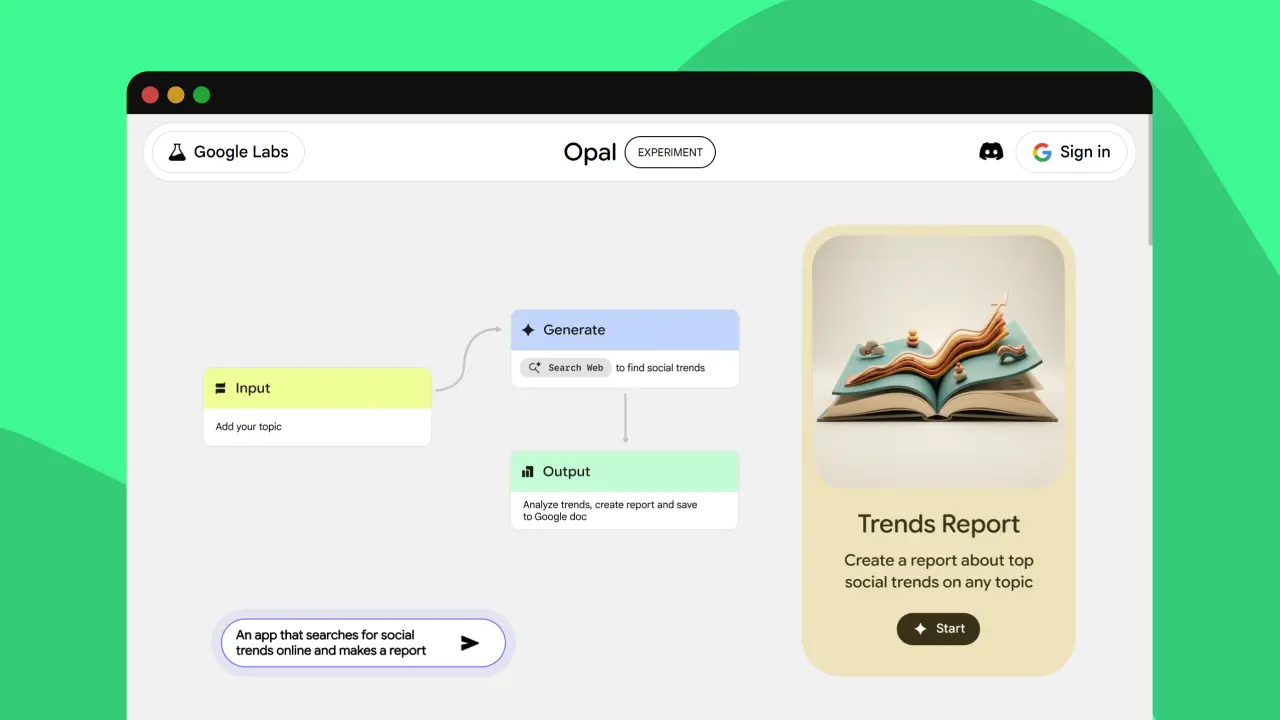
What if you could build functional AI applications in minutes, without writing a single line of code? That’s exactly what Google Labs has achieved with Opal. This no-code platform lets you chain together prompts, Gemini models, and external tools through an intuitive, node-based visual interface. Whether you’re looking to automate internal workflows, prototype ideas for a startup, or create dynamic assistants, Opal removes the technical barrier so you can develop at the speed of your imagination.
What is Google Opal, and why is it a game-changer?
Opal is an experimental platform from Google Labs that redefines AI-assisted development. Its main goal is to democratize the creation of “mini-apps”: small applications focused on specific tasks that leverage the power of Gemini models.
Unlike a traditional chat where each interaction is independent, in Opal you build a replicable workflow. You’re designing the brain and logic behind the interaction, ensuring that the AI behaves consistently every time the application runs.
From natural language to visual workflows (drag-and-drop)
One of Opal’s most impressive features is its ability to translate a simple description in natural language into an architecture of interconnected nodes. You can tell Opal, “Create an app that analyzes a PDF and generates a Twitter thread,” and the platform will visually generate the necessary components (document input, Gemini processing, and text output) ready for customization.
Practical use cases for creators and small and medium-sized businesses
Opal isn't just for developers; in fact, it really shines when used by content creators and small businesses that need agile solutions.
- Rapid prototyping of MVPs: Validate business ideas that require AI in a matter of hours, not weeks.
- Mass content generation: Create workflows that take data from a database and automatically generate product descriptions, social media posts, or personalized articles.
- Automated data analysis: Set up agents to process sales reports or customer feedback to extract actionable insights without constant human intervention.
Dynamic agents and contextual memory
The latest updates have introduced autonomous agent capabilities. Now, workflows are no longer strictly linear; you can set up decision nodes where the AI chooses the next step based on the previous outcome. In addition, contextual memory allows mini-apps to remember user preferences or data from previous sessions, creating a much more personalized and professional experience.
How to Publish and Share Your First Mini-App
Once you’ve perfected your workflow in the Visual Editor, sharing it is incredibly simple. Opal handles all the backend work. With a single click, you can generate a working public link.
Your application runs directly on Google’s infrastructure, ensuring speed and security. You can send this link to clients, use it internally within your team, or even embed it on other websites, bringing your custom AI solutions to where they’re truly needed.
Get started building with Opal
You can access the tool directly in opal.google.
Sources used in this Post
Did you like this content?
If you want to keep seeing this type of content, you can support me with a donation via PayPal.